Old Town €€€ Higher prices
Best for: First-timers
The Main Square, St Mary's Basilica and the Cloth Hall on foot.
A royal old town, deep history and great value.

Kraków combines one of Europe's finest medieval squares with two of its most important visits outside the city: the Wieliczka Salt Mine and the Auschwitz-Birkenau Memorial.
Plan three days: one for the old town and Wawel, one for Kazimierz, and one for Auschwitz or Wieliczka.
You can wander Kraków for free. These five you'll end up paying for, so book them before you fly.
The former Nazi German camp, now a memorial and museum.
Our tip: Entry must be booked and guided visits are required at peak times. Tickets go weeks ahead; allow about seven hours with transport.

Underground chapels and lakes carved out of salt, 135 metres down.
Our tip: Visits are guided only; about 800 steps down, lift back up.
The castle and cathedral of Polish kings, on a hill above the Vistula.
Our tip: Exhibitions have separate tickets and daily limits. Book early in summer.

The museum of Kraków under Nazi occupation, in Oskar Schindler's factory.
Our tip: Timed tickets with small capacity; book ahead.

Poland's mountain town, with wooden houses and a funicular to the peaks.
Our tip: A full day; dress for mountain weather.

In Kraków, where you sleep decides how much of the city you see on foot. These are the areas we recommend, and who each one suits.
€€€ €€ € Price levels compare the areas within this city.
Best for: First-timers
The Main Square, St Mary's Basilica and the Cloth Hall on foot.
Best for: Couples and food lovers
The historic Jewish quarter, now full of cafés, bars and restaurants.
Best for: Value and quiet
Across the Vistula, near Schindler's Factory. Calmer and cheaper, a short walk from Kazimierz.
Three picks per question, chosen with our selection criteria, with price ranges and what nobody tells you.
About 20 min to the main station
Fast and cheap, right next to the old town.

About 40 min
Cheapest option, with stops near the centre.

About 25 min
Inexpensive here; book ahead to avoid surprises.
The 10 questions everyone asks before going, answered straight.
Yes, Kraków is very safe. The main nuisances are noisy stag parties in the Old Town at weekends and pickpockets in the Main Square. The currency is the złoty (PLN): compare exchange office rates before changing money, and use an app for taxis.
April to June and September are the best months. Summer is warm and busy, and December brings the Christmas market to the Main Square. Winter is cold, often below zero, but cheaper.
Polish. English is common among younger people and in tourism. "Dzień dobry" means good day.
Three days is ideal: one for the Old Town and Wawel, one for Kazimierz and Podgórze, and one for Auschwitz-Birkenau. The Wieliczka Salt Mine takes half a day. With more time, add Zakopane and the Tatra Mountains.
The Main Square, the stalls of the Cloth Hall and the hourly bugle call from the tower of St Mary's are free. So are Wawel Hill and its courtyard (the castle and cathedral interiors are paid), the streets of Kazimierz, Planty Park, St Florian's Gate, the Vistula riverside and the fire-breathing Wawel Dragon. Entry to the Auschwitz-Birkenau Memorial is free with a reservation, but at the busiest times you can only enter with a paid guided visit.
The Rynek Underground museum beneath the Main Square and Schindler's Factory are essential. Add the Wawel State Rooms and Treasury, the Czartoryski Museum (home of Leonardo's Lady with an Ermine), the Galicia Jewish Museum and the Polish Aviation Museum.
Poles are reserved at first and very hospitable once you get to know them. Catholic traditions are strong, so be respectful in churches. Tipping around 10% is usual in restaurants, but be careful: saying "dziękuję" (thank you) when handing over the money usually means "keep the change".
Try pierogi (dumplings), żurek (sour rye soup, often served in a bread bowl), bigos (hunter's stew), kiełbasa, the zapiekanka from Plac Nowy in Kazimierz, obwarzanek (Kraków's ring-shaped pretzel) and oscypek (smoked sheep cheese). To drink, Polish vodka or beer.
The Old Town is the most central, at higher prices. Kazimierz is lively, with cafés and bars, at mid-range prices. Podgórze, across the river, is local and cheaper.

An eSIM is a digital SIM you install on your phone before you fly. No plastic card, no shop at the airport: you land, switch it on and you're online.
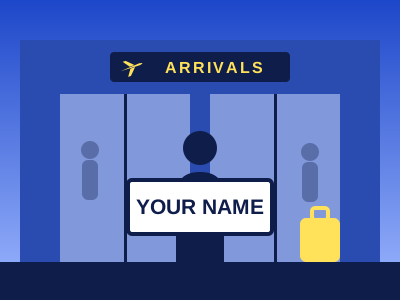
Book your airport-to-hotel and hotel-to-airport transfers in advance and forget about the taxi queue, the bargaining and the 'where do we go now?'. When you walk out of arrivals, someone is already waiting with a sign with your name on it, helps you with the bags and takes you straight to the door.